
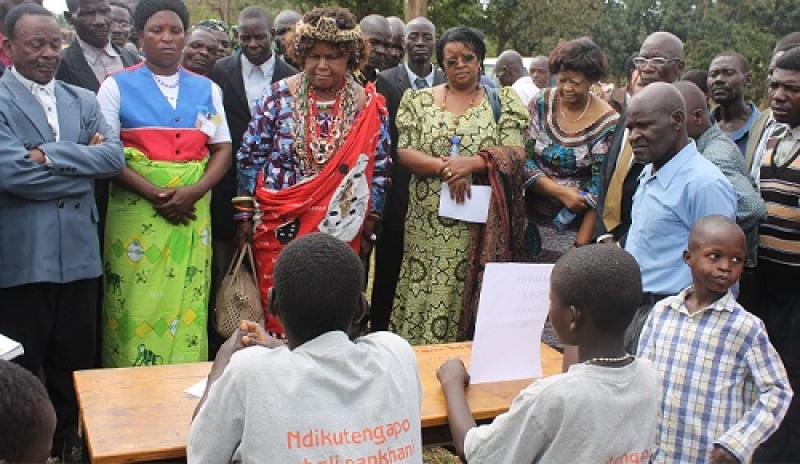
Welcome to one of the cleanest villages in Malawi; a village where ICT has been taken to another level. In 2006, this village received an award from the Ministry of Health as a cleanest village. Here, every structure has a message, boldly handwritten on it. From houses to trees, the messages range from maternal and child health to promoting girls education through antidrug abuse and violence against women messages. This is Pitala Village in Mchinji district.On 9th May, 2015, Pitala and the surrounding villages were celebrating 15 years of no maternal and newborn death. It was an event organized with pomp where Pitala showed off it what has taken them to acquire this fit through music, dance, drama and paintings. The event was graced by the Director of Reproductive Health Unit (RHU), Mrs. Fanny Kachale as a guest of honour. Paramount Chief Gomani, the deputy director of the Presidential Initiative on Maternal Health and Safe Motherhood and the Member of Parliament for the area were some of the high profile guests of that day.In her words, STA Pitala reminded the gathering that their success story is that of from rags to riches. She explained that her area was in 1999 identified by the Mchinji District Health office to be a beneficially of a UNFPA project after being noted that it was registering more maternal deaths. The UNFPA project lasted for five years up to early 2006 when they finally handed over the project to the Ministry of Health. Pitala and her subjects continued implementing whatever the UNFPA project taught them with guidance from the district hospital and Mkanda Health Centre, a nearby local hospital. They carried on like this until another six years later when PACHI came in with yet another project, Evidence For Action, (E4A) in their area with the Mamaye campaign. Since then Pitala is working with Mamaye and often being used as a model village where committees from other impact areas come and learn.STA Pitala’s area is mainly built on strong by-laws that promotes girls education and encourage women to attend antenatal clinic on time and always give birth at a clinic or hospital.During this event, the director of RHU on behalf of the Ministry of Health recommended people of Pitala for practicing what she termed as “good behaviours to sexual and reproductive health.” She further said Pitala has over the past years shown what lacks in most communities to uphold what they have been taught.The WHO estimates that of the 287, 000 women who die of pregnancy related complications each year, more than 99% die in low and middle income countries. Malawi is among these countries and neonatal mortality in Malawi accounts for 40% of all child mortality figures. Although no formal maternal death data has been reported to the national level, it is well known at institutional level, that maternal deaths occur all too frequently. Malawi cannot ignore the toll it is paying by the unnecessary loss of mothers who leave behind orphans and families.
In 2006, this village received an award from the Ministry of Health as a cleanest village. Here, every structure has a message, boldly handwritten on it. These messages range from maternal and child health to promoting girls education through antidrug abuse and violence against women messages.