
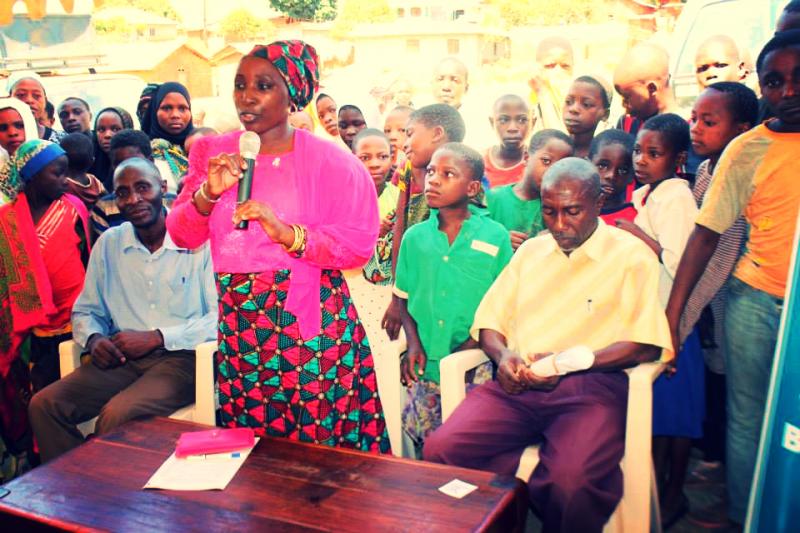
I say it is a game changer because am sure that if sustained it will improve service delivery, it will strengthen demand side accountability. It is a game changer because through Citizen Hearings citizens are provided with an opportunity to voice their priorities and concerns.
CITIZEN Hearings you may want to call it constructive engagement between citizens, policy makers and service providers so as to jointly solve a certain problem or problems or agreeing for a certain thing aimed at improving the present status quo, is surely a game changer and the way to go if we are to improve mothers, newborns, children and adolescent health. I can strongly attest to this.I say it is a game changer because am sure that if sustained it will improve service delivery, it will strengthen demand side accountability. It is a game changer because through Citizen Hearings citizens are provided with an opportunity to voice their priorities and concerns. For instance Citizen Hearings in Tanzania have demonstrated that citizens know better their problems and so do they when it comes to solutions, they were able to offer solutions to various challenges which before Citizen Hearings were placed on health sector or government shoulders. This really stunned me.For the first time in Tanzania and globally we witnessed citizens, and government seating together to discuss ways to improve maternal, newborns, children and adolescent health now and in the post 2015. Tanzania national Citizen HearingsIn March this year maternal and newborn health stakeholders flocked to Tanga region to observe the tenth White Ribbon Day, a yearly event that takes place on 15th of March every year since 2004. The Tanga event was an unprecedented one, it has never happened before, it ushered in a game changer in Reproductive Maternal, Newborn, Children and Adolescent Health (RMNCAH) outcomes, by opening a door for citizens led accountability.For the first time in Tanzania, through the exercise dubbed Citizens Hearing, service providers i.e. government officials, politicians sat together with CSOs, children, youth, adolescents and citizens so as to jointly address obstacles holding Tanzania from averting preventable maternal, newborn, children’s deaths.The events started in Handeni, followed by Kilindi, Korogwe, Muheza, Tanga City and climaxed in Dar es Salaam covering key layers of government administration i.e. ward, district, regional and national.The conversations, call it accountability conversations if you want, revealed that, engagement or collaborative problem solving between citizens and duty bearers was lacking, information dissemination from both the government and CSOs wasn’t there, even that information that was meant for community consumption hasn’t trickled down to the very people who were meant to use it, as testified below.“I am a member of health committee in my village. I did not know that there is a budget for mothers and newborns services. Thanks to White Ribbon Alliance, this is the first time I hear about it and I take it as a challenge. When I go back to my village, I will question our in charge at our dispensary about this budget,” One citizen was quoted as saying at Handeni Citizen Hearing event.To make citizens more engaged the media was part of the core team, the press reported all events. Apart from helping to amplify what was happening, involving the media in Citizens Hearings has immediate and long term benefits. The media plays a crucial role when it comes to promoting accountability, media makes citizens aware and hence engaged in governance process, the media monitors, investigates and criticizes.The media also helped us to put Citizens Hearing on the agenda, while journalists don’t tell us what to think, they do tell us what to think about, the media has the power to determine what we talk about as individuals and address as a nation. If the media place maternal and newborn health on the agenda, then the people will begin to pay more attention to improving maternal and newborn health. This calls for continued thinking of how best we can continue engaging the media, not telling them what to write through press releases, but strategically engaging them.The accountability conversations from Handeni, Kilindi, Korogwe, Muheza, Tanga and Dar es Salaam, resulted into a long list of issues, which later were summed up into three categories, namely: access to quality health services; community empowerment and engagement; and improving accountability for RMNCAH.Quality of care is a big problem in most health facilities. To end preventable maternal and newborn morbidity and mortality, every pregnant woman and newborn need skilled care at birth with evidence-based practices delivered in a humane, supportive environment.Evidence has it that, every year Tanzania loses 39,000 babies who don’t live beyond 28 days, and 47,000 babies are born dead (stillbirth), half of them dying during delivery, meaning that, by the time labour begins the newborn is alive but dies during the process of labour, something which signifies a serious problem in quality of care.According to Kate Gilmore, Deputy Executive Director, (Programme) and Assistant Secretary General, United Nations Population Fund (UNFPA), without improving quality of Care the world isn’t going to reach Sustainable Development Goals (SDGs) targets related to ending maternal and newborn deaths, as about 80% of maternal and newborn deaths could be prevented provided every pregnant woman and newborn received quality care at the start of life (pregnancy) cycle, particularly care during birth, and the first week of life. Nobody is questioned, nobody is held to account for these preventable newborn deaths or mothers deaths. We know why mothers and newborns die, and we know what needs to be done to save the lives of innocent mothers and newborns. What is lacking is accountability. That is why citizens place high hopes on Citizens Hearing. It is expected that the empowerment through Citizens Hearing will make citizens seek answers to every pregnant woman dying due to pregnancy related complications, likewise to every newborn.If citizens are informed that there are things called Life Saving Commodities which can prevent newborn deaths, when death happens, at least they will be able to question if the facility had Life Saving Commodities and many more relevant questions, all they need is information on the service they deserve, quality and performance standards required. This is one of the empowerment citizens need. The government can do this, CSOs can do this, and the media can do this.The government has many instruments for accountability or for checks and balances, there is the legislative, the executive and judiciary, in some places opinion/comments boxes are in place. In some other government departments the government has complaints or grievance handling mechanisms, but they are not followed. Why I don’t know, but my guts feeling tells me that it could be people have not seen the outcome of those mechanisms.What is clear and common is that, at times these government accountability organs fail to function as they should, and when that happens it is the poor people and vulnerable people like pregnant women, newborn and children who suffer most, hence calling for bottom up accountability whereby those who are meant to benefit from services are empowered to hold service providers accountable for their commission and ommission.The benefit delivered from demand side driven planning benefit both the supply side and the demand side, as they enable the government to come up with interventions that are responsive to what exactly people need. We have witnessed in some instances whereby interventions fail due to the fact that citizens weren’t involved in the planning stage, hence the intervention lack ownership and in the end flop. When it comes to the power of listening to beneficiaries and planning being informed by their knowledge/ inputs of service users I can’t emphasize more on that. Policy makers need feedback, managers need feedback on how frontline people are interacting with clients, this feedback can come from frontline people themselves, but the most important feedback is that which comes from clients or service users, service users can tell you, whether they are satisfied with the service or product, they can tell you what works and what doesn’t work. So improving relationship between service providers and service users is fundamental for improved service delivery. That is why Citizens Hearing or accountability conversation which took place are the way to go as intoned by the Tanga Regional Medical Officer Dr Asha Mahita.“These meetings should be sustained, as they help us as managers to get feedback on the services we provide to people,” Dr Mahita told the audience in Tanga City adding that sometimes people fear to report when they are mishandled for fear of reprisal, but here I can see people are freely pointing out abuses done to them and suggesting solutions for the future so as to improve the situation.This is great: service providers and service users will continue to interact strengthening their relationship is something which even angels in Heaven are happy with. We can ignore feedback, but the consequences of ignoring feedback can’t ignore us.I echo Dr Mahita’s statement, if you look deep down, government officials deliver power or authority from citizens and hence are accountable to citizens. In other words government officials are agents and citizens are principles. Government officials are given the powers and authority to perform tasks and duties on behalf of citizens, that being the case Citizens Hearing is crucial in making sure that the government is responsive to citizens needs and steer social accountability.I can’t deny that there were times when the discussion veered off. Doing the facilitation I could see clearly the two groups veering away from the key issue and start blaming games, this is where facilitation skills were needed most, to bring them back to the main issue so that collaboratively the two sides can come up with the solution. This is called collaborative problem solving. Collaborative problem solving fosters ownership and strengthens relationship. Trust me If relationship works everything works. At the heart of Citizens Hearing no one was left behind we had councilors and ward governors or ward executive officers (WEOs), village executive officers (VEOs), influential people from communities, religious leaders, basically people from all walks of life at the community level attending Citizens Hearing.Dr Mshiu from the Ministry of Health and Social Welfare, was there to represent the ministry in all the hearings and played a key role in terms of clarifying policy issues; children on their part demonstrated the importance of being heard as they voiced their concerns.Among many things voiced by children one of it was that, they see their colleagues who have lost their mothers psychologically being affected something which affects them academically. Trust me, these are painful memories to the father, and children, losing a mother for reasons that can be prevented when the mother is bringing new life on earth is unacceptable, as it denies the mother her right to life and the right to good health.It is unacceptable to lose a mother when the mother is fulfilling her biological duties, likewise losing an expected new guest in the family on preventable causes is unacceptable as well as like mentioned above goes against human rights. One good thing is that all Citizens Hearing events were facilitated by myself. As I was facilitating I couldn’t bear the pain when Idd, a child from Handeni Children’s Council under Save the Children shared this with the audience 'My mother was in labor pain, she was sent to our dispensary. She had an emergence but unfortunately the ambulance was not there. They managed to hire a private car but because of the nature of that car and her condition, my mother could not fasten the car belts. During the drive to Korogwe, the driver stopped the car abruptly and my mother fell from the seat. Upon reaching the hospital, the baby died but my mother survived'.I like the term social accountability, as it means constructive engagement as opposed to putting either side on spot. The atmosphere created during Citizen Hearings was social with mutual respect between the two sides, government and citizens. They were all bound together by the common reality that women, children, newborns and adolescents are dying from preventable death. What need to be done to avert these preventable deaths? The dialogues focused more on looking for the solution as opposed to debating the problem.When we came to the way forward, I was amazed when I later learnt that the joint recommendations reached between citizens and government officials were in alignment with key government documents, the National Strategy for Growth and Poverty Reduction and The Sharpened One Plan, and Big Result Now (BRN).The joint recommendations fits very well with the Countdown Policy Brief launched together with the Sharpened One Plan last year, closely echoing Call to Action for Health Care Providers and Call to Action for Communities, Call to Actions for National Leaders and Parliamentarians and Call to Action for Health Systems Leaders.Citizens called for improved accountability so that mothers and newborns can survive, The National Strategy for Growth and Reduction of Poverty (NSGRP II, or MKUKUTA II in Swahili) stresses on Good governance and accountability as fundamental components to shaping a favorable environment for economic growth and poverty reduction. Good Governance and Accountability are given a central role in reaching the goals and objectives of MKUKUTA II.NSGRP II is one of the crucial documents for improved RMNCH as mentioned in The Sharpened One Plan. “Ensure that RMNCH priorities remain prominent in the post-2015 era, including the HSSP IV and National Strategy for Growth and Reduction of Poverty (NSGRP/MKUKUTA)’” reads part of Sharpened One Plan’s Call to Action for National Leaders and Parliamentarians.Gains from Citizens Hearing dialogues should be sustained and help to inform similar events in other parts of the country. They are the building blocks for accountability on RMNCAH. With Citizens Hearings everyone pledged to play his or her part, so that mothers and newborns can survive. Let us all support this bottom up accountability, empower citizens to influence the quality RMNCAH service delivery by holding themselves and the government accountable.The concept for Citizen Hearings was hatched by a partnership between IPPF, White Ribbon Alliance for Safe Motherhood, Save the Children, and World Vision at international level. In Tanzania the Citizens Hearings were led by White Ribbon Alliance for Safe Motherhood Tanzania, Evidence for Action (E4A) Tanzania, Save the Children, World Vision, UMATI, JHPIEGO, TAMA, Ministry of Health and Social Welfare, Muhimbili National Hospital, and T-MARC. See the concurrent blog on how Citizen Hearings from Tanzania reached a global audience.Author: Kenneth Simbaya is a journalist and community engagement consultant