
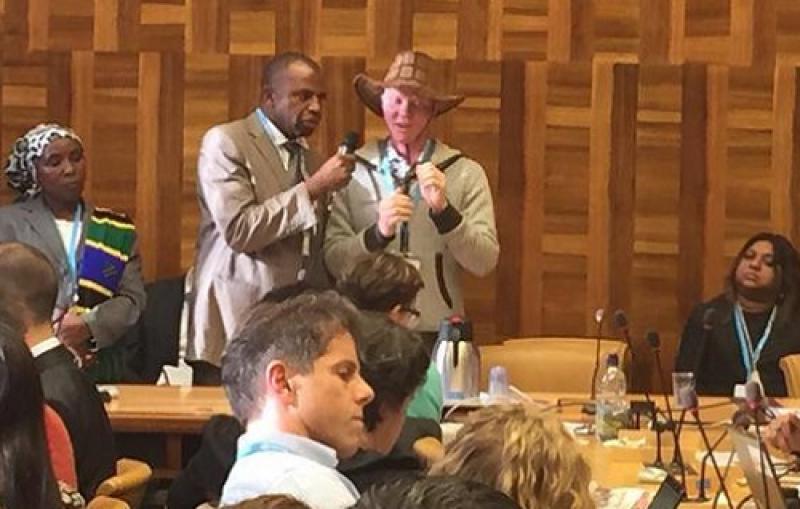
This is historic! This is ground breaking! Declared Richard Horton, the co-chair of Independent Expert Review Group (iERG), when opening the first ever global dialogue between citizens and governments to be held at the World Health Assembly, that took place on Thursday May 21st 2015, at Palais de Nations conference room in Geneva, building on from national dialogues which took place in several countries around the world. Tanzania was represented by David Lyamuya, who coordinated national Citizens Hearings in Tanzania; Khalid Mohamed Mngulu, a child from Handeni Children’s Council under Save the Children; Mwajuma Khatibu Sempule a councilor from Kwediboma ward in Kilindi district; and Kenny Simbaya, a journalist who as well as covering the events, also facilitated the Citizens Hearings in all districts. Also present at the global dialogue were Daudi Gambo from World Vision Tanzania, Jasminka Milovanovic and Daudi Buswelo from Save the Children Tanzania.L-R: David Lyamuya speaking at Special Citizen Hearing session in Geneva, Hon Mwajuma Khatib Sempule, Kenneth Simbaya (author) and Khalid Mohamed MnguluOpening the global dialogue, Horton who is also the Editor-in-Chief of The Lancet, an international medical journal which publishes various research on health, said the event was a historical moment as that was the first ever dialogue between citizens and governments in the history of the World Health Assembly pointing out that now that the dialogue has started it isn’t going to stop.Flavia Bustreo, World Health Organization (WHO), Assistant Director General expressed WHO’s full support to citizen-led accountability, “ WHO is committed to accountability” she said adding that, “Am delighted to be here with you to witness this historical moment.”Flavia said that the recommendation by iERG on having Citizens Hearing in countries which will culminate to global Citizens Hearing is an answer to strengthen social accountability for mothers, newborn, children and adolescents.“We have seen our mothers die from preventable causes due to lack of services in health facilities,” said Khalid Mngulu a child citizen representative at the global dialogue from Handeni Tanga in Tanzania.“We elected leaders, like ward councilors are people’s representative, we need to act as a bridge between citizens and government, as well as play our watchdog role effectively,” said Mwajuma Khatibu Sempule from Kilindi when sharing her experience on Tanzania national Citizens Hearing at the global dialogue.“We want, quality, affordable health services including family planning services,” said Ibil Surya a youth citizen representative at the global dialogue from Indonesia.Lucien Kouakou, International Planned Parent Federation (IPPF) Regional Director for Africa commended citizens for being brave and hungry to raise voices of the voiceless. Stefan Germann, from World Vision Geneva, called for the Global dialogue to be institutionalized in the World Health Assembly structure and next time the dialogue should take place in the general assembly hall.On his part Bernard Haufiku, the Namibia Minister of Health insisted on the importance of connecting with communities.“Working together we can make good progress, not just for women and youth, but for men too,” said the Minister for Health from Indonesia.Betsy McCallon, White Ribbon Alliance (WRA) Executive Director, said citizens’ hearings and dialogues have many purposes, including: directly feeding content for the post 2015 agenda/ Global Strategy 2.0 at global and national levels, opening and strengthening channels of accountability to address barriers, identify solutions, and make progress.“It is not about a laundry list of demands, making people a little nervous – and that’s a good thing!,” she said adding that, it is pushing NGOs to talk about their own accountability, as well as NGOs role in holding others to account so as to make sure that they are delivering almost real time, specific, demonstrable results in the form of amended policies, subnational budget allocation, improved distribution of supplies and drugs, recruitment and retention of health workers, and improved privacy, confidentiality and respectful delivery of health care services.Through this process, McCallon said, we are calling for citizen participation to be at the heart of accountability mechanisms currently under development at every single level.“We are calling for this not only as a principle, but as an imperative for us to truly see impact for women, newborns, children, and adolescents,” stressed the Global WRA Executive Director.Dena Ringold, Alaka Holla, Maragaret Koziol and Santhosh Srinivasan, in their book Citizens and Service Delivery, Assessing the Use of Social Accountability Approaches in the Human Development Sectors, they say: In many low and middle income countries, failures in quality of public service delivery are demonstrated by high rate of absenteeism, among teachers, doctors, leakage of public funds intended for school or health facility, shortages and stock outs of pharmaceuticals and text books. These failures have driven the agenda for better governance and accountability. Governments, CSOs and donors have become increasingly interested in the idea that citizens can contribute to improved quality of service delivery by holding policy makers and providers of services accountable. This proposition is particular resonant when it comes to human development (HD) sectors; health, education and social protection which involves close interaction between providers and citizens who use their services.According to Ringold, Holla, Koziol and Srinivasan, relationship between providers and individuals citizens is complex and may not change easily or quickly. Citizens may not be willing to challenge providers if they lack information or time or if they do not feel empowered to do so. The latter is particular salient in low income countries, where providers may come from more affluent backgrounds and citizens may not feel in a position to question them. People may not think that they have the right or authority to challenge a teacher or a doctor because of their status, credentials, or knowledge, or they may be concerned about repercussions of giving negative feedback. Lack of information and empowerment limits the extent to which citizens interact with providers.Therefore, the potential for citizens to hold government accountable will largely depend on how the government, CSOs and the media provide citizens with information and how government, CSOs and the media create the opportunity for citizens to transform the information into action.The government, CSOs, the media can do this by informing citizens individually and collectively about what they deserve to get, i.e. that it is their right to get better health services, that women deserve respectful maternity care, etc. Given the information citizens will be able to use it to seek answers from people they have entrusted to serve them.Responding to a question from Katy Woods from WRA Global, which sought the opinion of the Tanzania Minister for Health and Social Welfare Dr. Seif Rashid on citizens engagement, the minister strongly supported citizens engagement, saying it is crucial, nothing can happen if citizens aren’t engaged. I can’t agree more with the minister. Citizen Engagement in various ways is a better way to stimulate demand for better services, behavior change, like sensitizing women to deliver in health facilities, attending prenatal and postnatal, clinics, encouraging community members to observe hygienic behaviors so as to avoid diseases like diarrohea etc.Evidence on the importance of citizens engagement is abound. WHO’s People-centered and integrated health services: an overview of the evidence interim report asserts that, despite government and donor efforts to strengthen health services provision, users still found services to be grossly inadequate, inequitable, poorly coordinated and lacking in the understanding of people’s priorities.Hence the report came up with seven recommendations, first highlighted the need to establish mechanism to increase provider’s awareness on the multidimensional and complex nature of health that is perceived by communities to constitute physical, mental, emotional, social and economic well-being including involving the community in making policy decisions through enhanced community representation, ownership, and participation. This is a powerful assertion and I can’t agree more to it. This reminds me of Steven Coveys writings, “Seek first to understand, to be understood.” In service provision it is important to understand users needs, if we are to provide relevant services to them. Marketers know this very well, if you sell a commodity that no one needs, there won’t be sales. Period.“Bees have no law, no police, no religion, no moral training, what they do have is a very high developed sense of social responsibility. They know that their only hope of survival is to work together. We have constitution, laws, a police force, and hearts that are capable of infinite love. Yet we lack a strong sense of social responsibility …” Tenzin Gyatso, the fourteenth Dalai Lama.Progressive societies have learnt that policy or strategies without majority support isn’t sustainable. Citizens Hearings have opened the door: its’ time to work together so that our mothers, newborns, children, and adolescents can enjoy the quality health services they deserve.What we need to do now is agreeing on what next, who does what, by when and the follow up mechanism. This is important as citizen hearings need to lead to actions. The next stage is important to reinforce commitment and move to actions Residents of Kilindi, Tanga following proceedings at a Citizens' Hearing session WRA, IPPF/UMATI, World Vision, Save the Children, Evidence for Action, and other partners will continue to mobilize political and citizens support to Citizens Hearing as the best interface to strengthen social accountability for RMNCAH issues, with hope that Citizens Hearing will stop business as usual.Citizens' recommendations from all countries that have held Citizens Hearing apart from being shared at the 68th World Health Assembly, they were also presented to The UN Secretary General Ban Kim Moon, while those from Tanzania and Uganda were also shared at the Second East Africa Health Ministers and Parliamentarians Forum held in Uganda earlier in March 2015.The concept for Citizen Hearings was hatched by a partnership between IPPF, White Ribbon Alliance for Safe Motherhood, Save the Children, and World Vision at international level. In Tanzania the Citizens Hearings were led by White Ribbon Alliance for Safe Motherhood Tanzania, Evidence for Action (E4A) Tanzania, Save the Children, World Vision, UMATI, JHPIEGO, TAMA, Ministry of Health and Social Welfare, Muhimbili National Hospital, and T-MARC. See the concurrent blogs on Citizen Hearings at national level in Tanzania for background.'Local voices go global through Citizens' Hearings' 'Ground breaking! Historical moment in RMNCH'
This is historic! This is ground breaking! declared Richard Horton when opening the first ever global dialogue between citizens and governments to be held at the World Health Assembly. Tanzania was well represented, taking the voice of our people to Geneva.