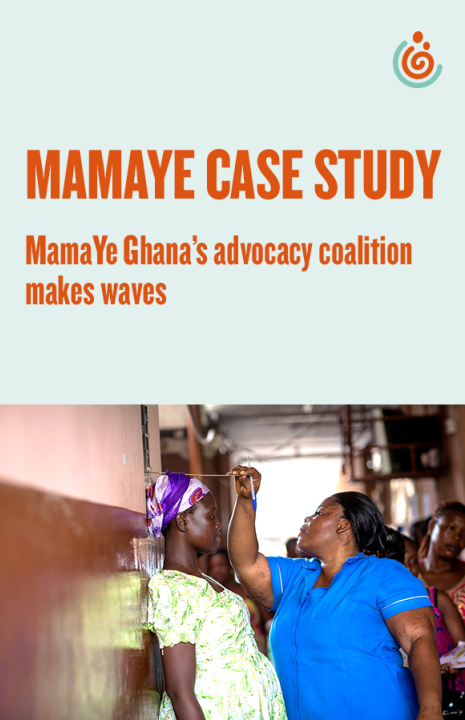
Scorecards jumpstart accountability and action at the facility level
This case study is part of our book, MamaYe Evidence for Action Stories of Change: Selected Case Studies. Through illustrative case studies, we describe how Evidence for Action - MamaYe has strategically combined evidence with advocacy and accountability activities in six countries, across Africa, and globally.
In the book, we bring to light new learning about the specific ways in which evidence, advocacy and accountability must work together to bring about change. One major area of learning has been the conditions under which evidence is used for decision-making.
In this case study, we indicate that favourable conditions involve the ownership of evidence through participation in data collection, analysis and review. We found that when those who are expected to use the evidence conduct data collection themselves, opposition to negative findings decreases and participants are motivated to address gaps, in settings as
diverse as Ghana’s facility scorecards.
Another favourable condition where evidence is used for decision-making is the involvement of strong accountability mechanisms to review the evidence and mandate action.
Accountability mechanisms set up by E4A-MamaYe involve non-governmental stakeholders such as citizens, civil society organisations, professional associations and the media having access to the same evidence as the government. It also means that these stakeholders have a space to engage government over what the evidence brings to light and what actions are required. These mechanisms have taken many different forms, including district interface meetings in Ghana.
A further area of learning has been the conditions under which advocacy leads to a change in perception in the general public that maternal and newborn survival is an important and achievable goal, as well as greater political will towards that goal.
Dissemination of health information, reframing the issue of maternal health towards hope and change, and mobilising activists from the general population greatly depends on messages being shared in a way that is sensitive to local cultural understandings. That is why
Ghana’s community MNH Councils have succeeded in driving social change: they have all involved the initial mobilisation of a small number of super-activists who have in turn mobilised others to influence decision-makers.
We also learned that greater use of evidence and higher political will lead to better use of resources only when the decision-makers with the power over those resources are the ones engaged through evidence, advocacy and accountability mechanisms. Initially, the Ghana facility scorecard system only engaged district level managers and politicians – however many of the gaps highlighted by the scorecards, such as human resources, could not be addressed at that level – in the second round of scorecard assessments, the region became a key stakeholder, which unlocked a greater spectrum of resources.
Evidence for Action-MamaYe. (2015). Scorecards jumpstart accountability and action at the facility level in Ghana.London: E4A-MamaYe.